/ GUIDES & INSPIRATION
Why Most Northern Lights Tour Photos Are Bad

Almost every northern lights tour in Iceland now advertises photos. Some include them, some charge extra, and a good number promise “professional photography” in the listing.
Then the gallery link arrives. Your face is a dark smudge. You’re cropped at the waist. The aurora is a green blur behind you and you’re standing somewhere in the bottom corner of the frame, too small to recognise.
It’s worth understanding why this happens so consistently, because the reason isn’t laziness. It’s structural.
The Two-Licence Problem
Think about what a northern lights guide actually has to be.
They need a commercial driving licence to carry passengers, in winter, on ice, often on roads that most visitors wouldn’t attempt. That’s a serious qualification and it takes time to earn.
They also need to be a night photographer. Aurora photography is one of the harder things you can do with a camera — long exposures in the dark, a moving subject, people who need to be lit separately from a sky that’s lighting itself.
Iceland has plenty of excellent commercial drivers. Iceland has plenty of excellent photographers. What’s genuinely rare is one person who is both.
So most companies hire for the licence, because without it the tour can’t legally run, and then hand that person a camera. Sometimes they hire enthusiastically — someone who owns a camera and takes nice pictures on holiday. That’s not the same skill.
Many of the people doing this work arrived in Iceland recently, and for a lot of them it’s their first season. Night photography isn’t something you pick up on the job — most photographers never learn it at all.
“Pro photos included” costs nothing to put on a booking page. Delivering them is the hard part.
What Actually Goes Wrong
The failures are consistent enough that you can spot them in almost any tour gallery. Here’s what they look like side by side — and note that in every pair the conditions were comparable. The difference is the person holding the camera.
The first is that you end up too small in your own photograph. The guide points the camera at the sky, because the sky is the impressive part, and the people become small shapes along the bottom edge. What you get is a picture of an aurora with some strangers in it.
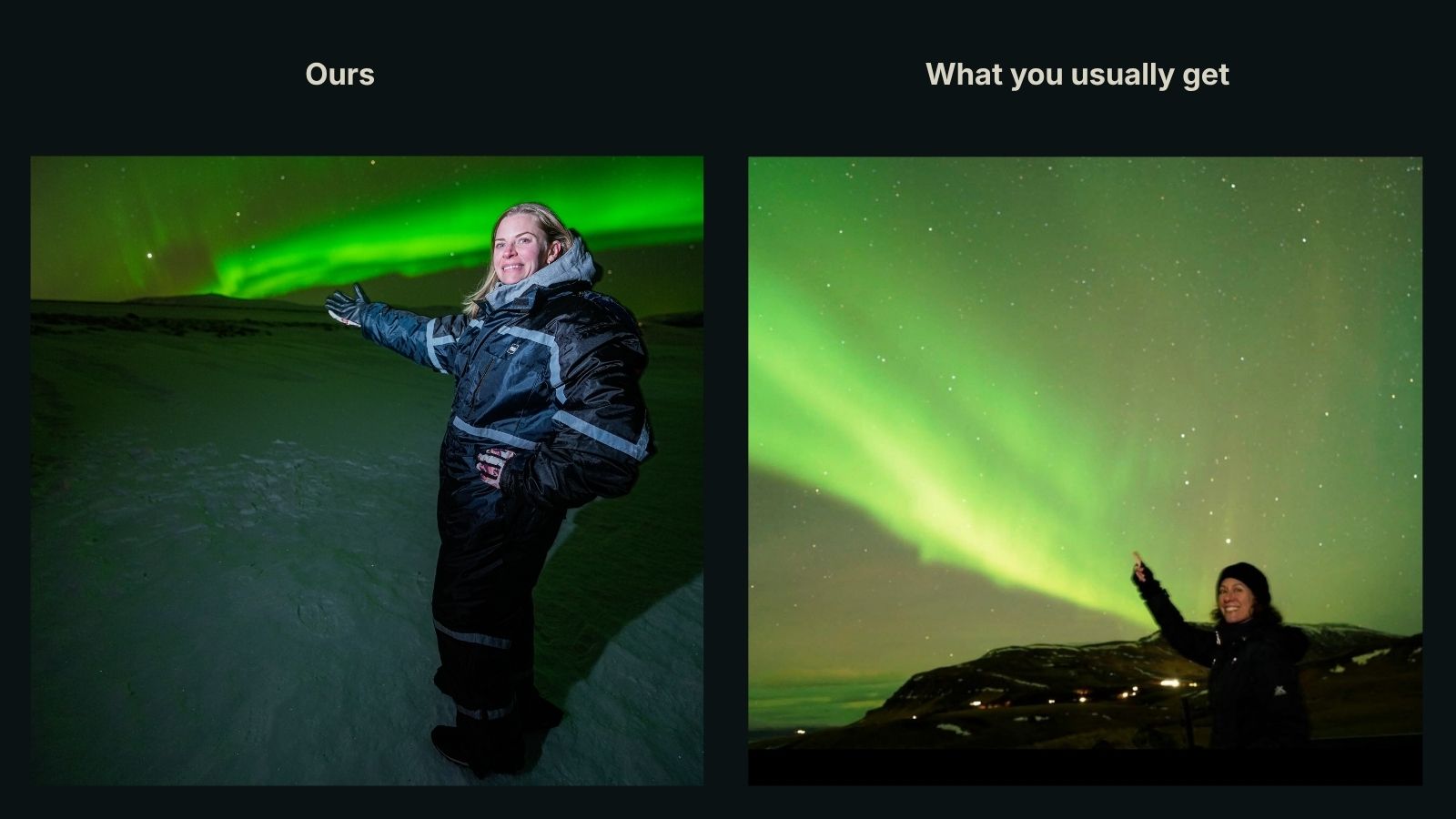
The second is that nobody is lit. The aurora lights itself. People don’t. Without a separate light source you get either silhouettes with no faces at all, or a burst of on-camera flash that blows the face out flat and white while everything behind it drops to black.
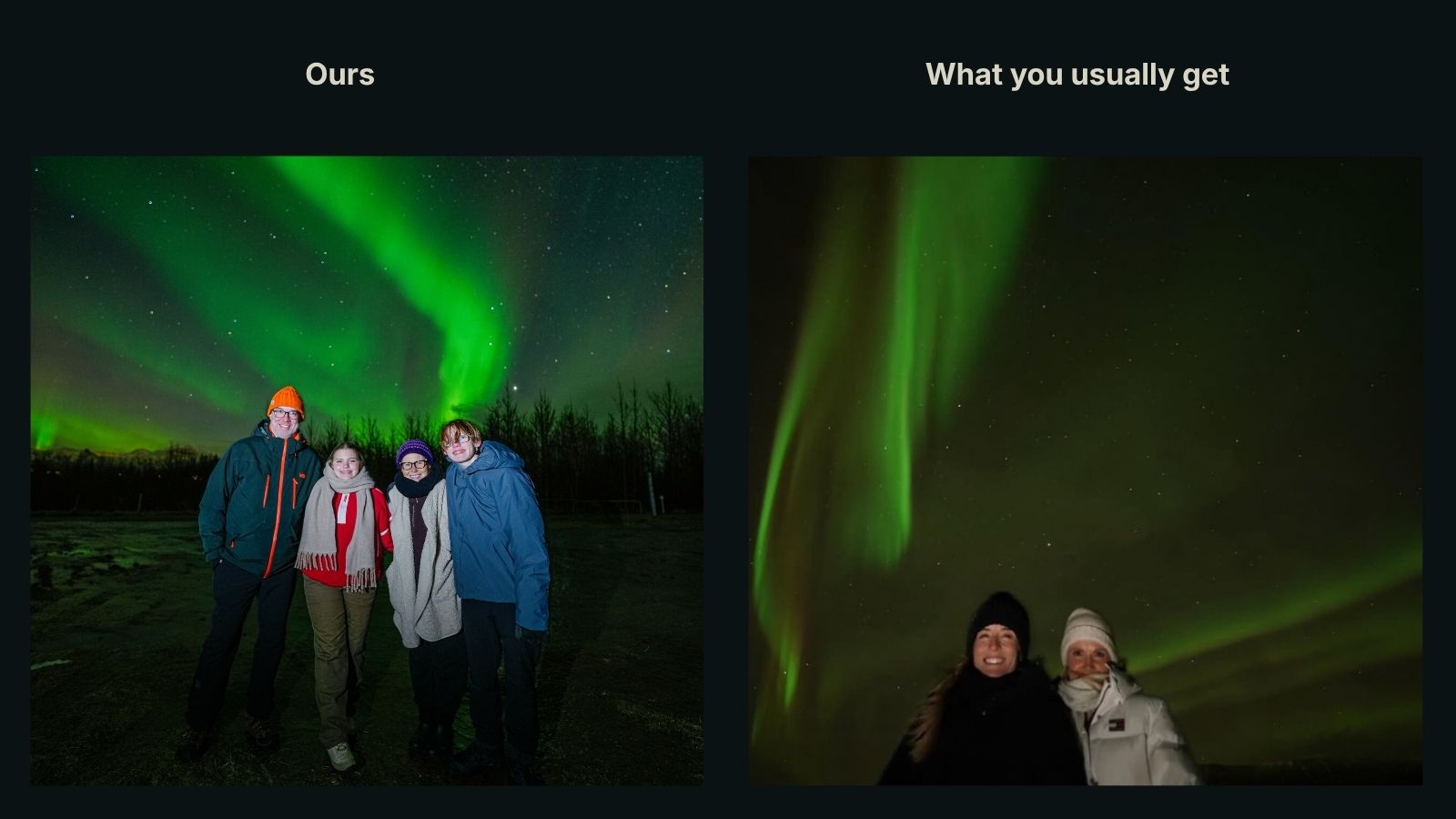
The third is framing. People cropped at the knees, standing dead centre, no foreground, no horizon, no sense of place. You can’t tell from the picture whether it was taken in Iceland or in a car park.
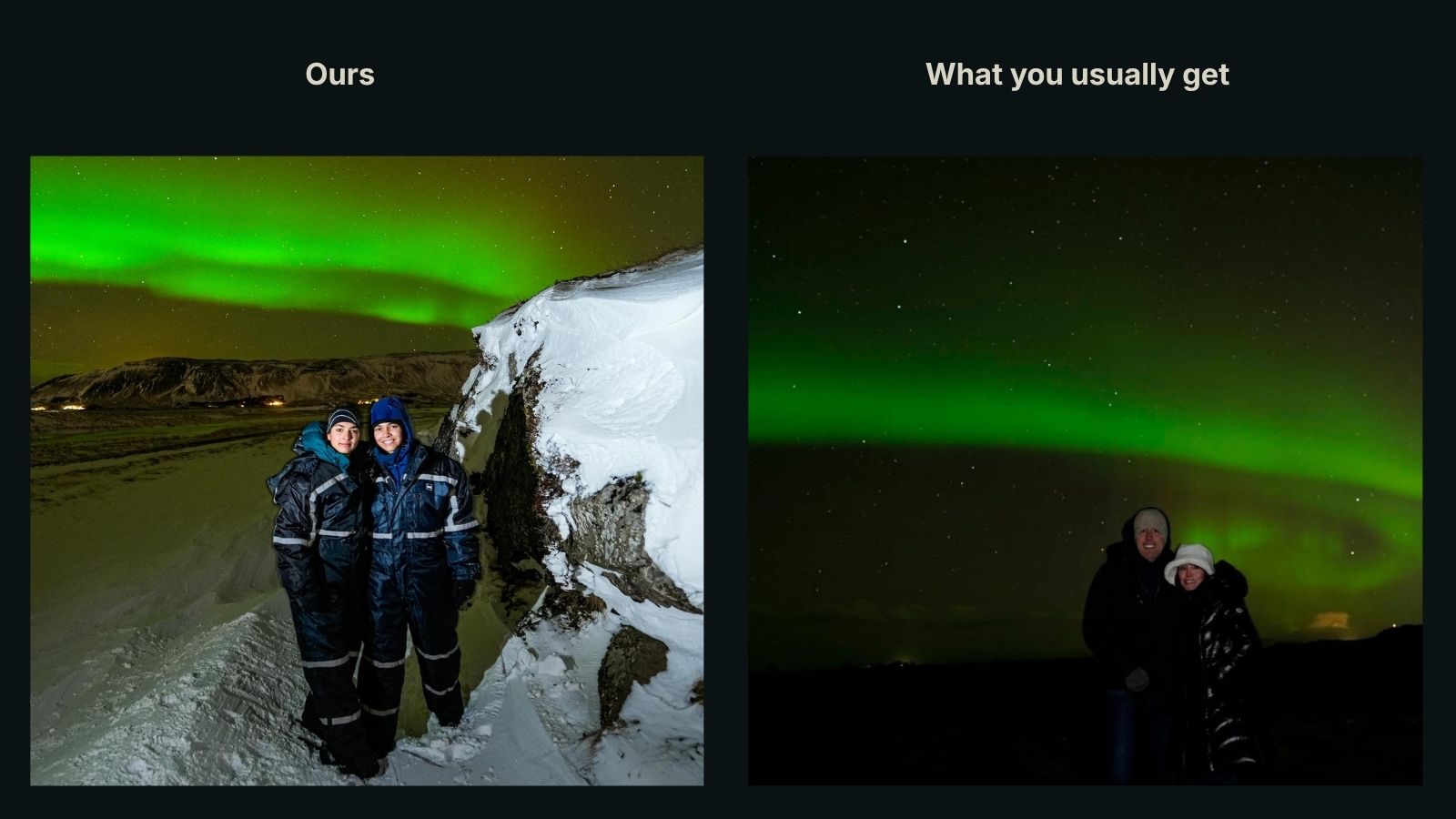
And underneath all of it, focus. Night photography is unforgiving — a slightly missed focus at a wide aperture, or a shutter a fraction too slow for someone breathing, and the whole frame is soft. On a phone screen it might pass. Printed, or full size, it doesn’t.
What We Do Instead
Our guides are both. Commercial licence and professional photographer, in the same person, on every tour.
That means the photography isn’t an add-on someone attempts at the end of the night. It’s built into how we run the evening — where we park, where we position you, when we shoot.
We use wide-angle lenses so you get the aurora and the landscape in the same frame rather than a tight crop of sky. We light you separately from the sky, so your face is visible and naturally exposed rather than either black or blown out. We shoot full-body compositions with the ground and horizon in them, so the photograph shows where you were, not just that something green was overhead.
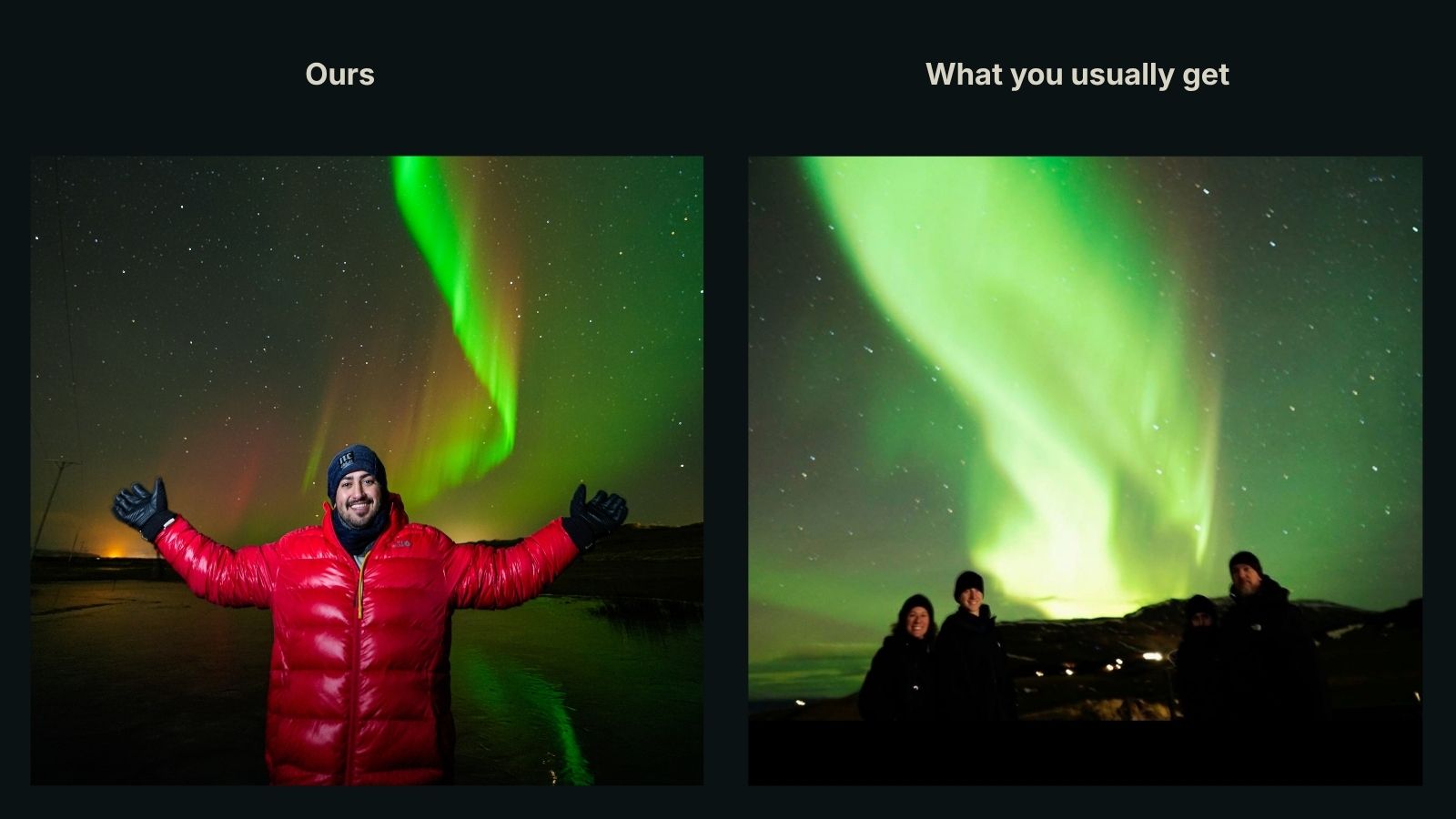
You get the photos within 24 hours of the tour, and they’re included — not an upsell, not a separate gallery you pay to unlock.
Why It Matters
You’ll be in Iceland once, most likely. The aurora will do whatever it does that night, and then it’s over.
What you take home is the photographs. If they’re dark, blurry, or don’t have you properly in them, then a large part of what you traveled here for is gone — and you won’t find out until you’re back at the hotel scrolling through them.
So when a listing says photography is included, it’s worth asking one more question: who’s taking them, and what else are they doing that night?

